



“Are you girls entertaining this gentleman,” Baldwin called, “or are you entertaining yourselves with this gentleman?”
“You get two guesses!” Ana said.
“And they’re both right,” Affrais added.
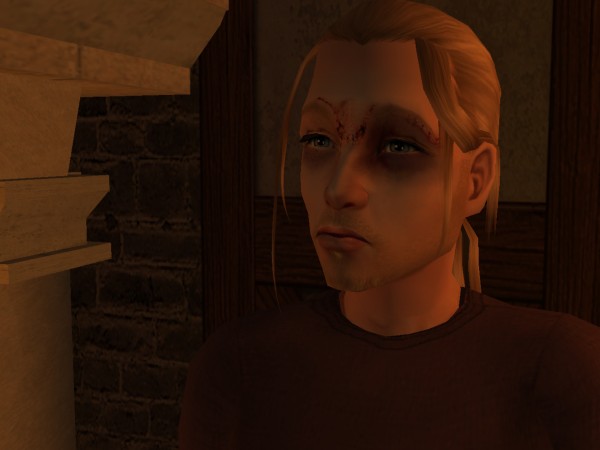
The young gentleman in question tried gamely to indicate his amusement with a smile, but a smile lacking the subtle participation of eyes and brows was at best an unreadable mask. In Njal’s case it looked more like a grimace of pain.

“Heill, Njal!” Baldwin grasped his shoulders and squeezed, hoping to reassure the awkward-looking lad that he had been delivered out of feminine hands.
Njal twitched and shrugged and finally raised his arms to give Baldwin’s shoulders a quick slap.
“Heill,” he replied softly.
With his next breath Baldwin inhaled a noseful of proof that Njal had not changed his shirt in days. Beneath his arms he reeked of man, but the rest of the fabric was steeped in the scent of sails stowed away damp, of steaming horses, of thawing mud. His neck was gray with several types of grime, black-ringed in the creases from hours spent with a bowed head, and striped with the fading tracks of trickling sweat or seawater, of melting snow, or of tears.

Baldwin took a step back, almost staggering. That brief contact had infected him with the young man’s awkwardness: he could not be the grim, battle-hardened soldier and the gaily genteel young knight at the same time. The giggling ladies would have to be removed from the room, or better yet the men.
“Shall we go up?” he suggested, pointing at the ceiling with his thumb. “I was just—”
“No!” Njal gasped. “So, I don’t stay a long time. I told my men, I said: if I do not come before tomorrow twilight, they go out with the rising tide.”
Baldwin glanced aside at the window and squinted into the bright light that struck at a steep angle off the snow. The family had scarcely come away from prayers, it was true, and Sunday dinner was still no farther along than a scuffling and a squawking in the yard, but the morning was getting on. To make it back to the coast by sundown tomorrow… A man would have to have a terrible urgency at his back, Baldwin decided, howling like the hounds of Hell.
“I give you a message for your King, only,” Njal added.

The ladies’ gowns rustled like silken wings as Affrais and her sister rose quietly together, understanding, though no one had addressed them a word. Baldwin thought their blithe disregard for their guest’s bedraggled appearance might have been their honest attempt to make him feel comfortable after all.
“Will you have some hot wine sent in for us, belles amies?” Baldwin murmured, moved with a throb of tenderness for his young wife. She knew little of the world besides what he had told her, and he had not told her much.
“It is already on its way, Baldwin,” Affrais smiled, scolding him softly for believing her so inattentive a hostess. She squeezed his elbow before she gave her own to her pregnant sister and led her waddling away.
Njal stared after them, nipping anxiously at his lower lip as though he thought he ought to say something to the retreating ladies, but could not guess what in any language. There was nothing in Njal but the awkward boy and the battle-hardened soldier, Baldwin thought; he did not know how to be genteel at any time.
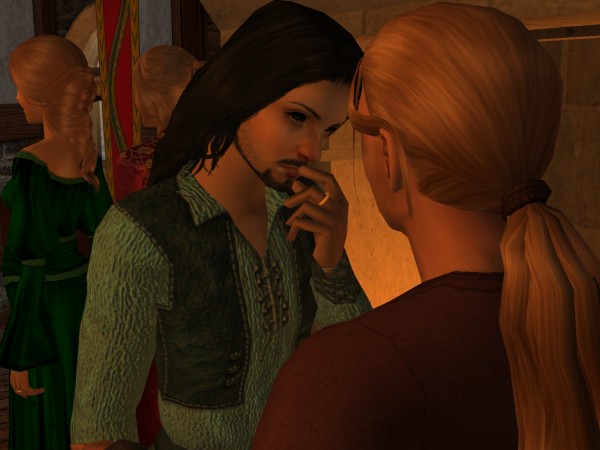
Indeed, Baldwin had never seen him out of the mighty shadows cast by Tryggve or Eirik. The appearance of a solitary Njal was a bad sign.
He clapped Njal on the shoulder to draw him back into the comfortable world of men. “Have a seat?” he offered.
Njal looked dubiously at the couch and shifted his weight uneasily from foot to foot.

Only then did it occur to Baldwin that the man must have ridden as fast from the coast to Lothere as he planned to ride from Lothere to the coast; and such a trip would have been a trial even for a pair of thighs accustomed to sitting a saddle.
“Never mind!” Baldwin laughed. “No sitting! Next time you get me on the deck of a pitching ship, I give you my permission to offer me a stand!”
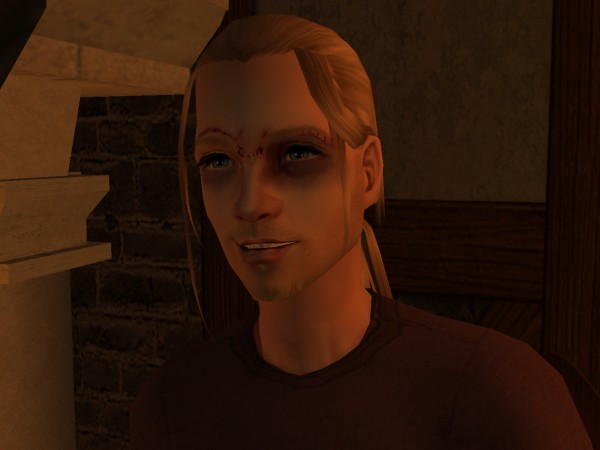
Njal lifted his head and offered himself the luxury of a wry smile. This time his eyes and scabbed brows cooperated, giving him a consistently raffish air. The last of his awkwardness melted away, and they met soldier to soldier, man to man.
“I don’t forget,” he warned.
“Fine, but if I fall in, you’ll have to jump in to save me.”
“Tsch!” Njal made some sound of Viking scorn and looked down. The fingers of his scarred hands were shaking, though they danced with a sailor’s skill over the complicated knots that fastened the drawstring of his purse. His mouth twisted into an uglier frown than Baldwin believed the joking threat had warranted, and the grotesque swelling of his brows made a dark scowl that the fair-faced lad never could have mustered on his own.
Baldwin could not help but stare at the wound. Surely it was not the work of a sword? A glancing blow, perhaps, from an axe such as the Norsemen favored? One of the long spears they wielded when they fought ship-to-ship at sea?
He did not think he had asked aloud, but Njal grunted and glanced up from his purse. “An oar.”

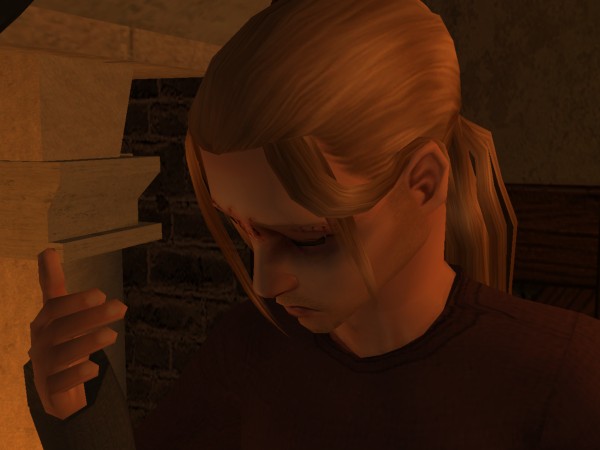
Baldwin sucked in his breath. He had never before looked on the sloping blade of a longship’s oar in light of the weapon it would make, but Njal had been all but scalped by the thing: his forehead had been laid open from the corner of one pale brow to the other. Someone had tended it, but the crude stitches had been swallowed by the swollen lips of the wound. The sockets of his eyes were so deeply bruised they puffed out like overripe dough. Half an inch lower and he would not have had eyes.
“I was in the water,” Njal muttered, shrugging one shoulder defensively in the universal, man-to-man sign of I don’t want to talk about it. “So.”
He pulled a square packet out of his purse and handed it to Baldwin without a word.
Baldwin immediately recognized the type of the flimsy, deeply yellowed parchment; the watery brown ink; the scrawl of a stubby, fine-nibbed pen; the brittle wax of the seal—the product of the portable writing kit of a literate general on the field of war.

In times past Baldwin had stood discreetly by while such letters were written—on a folding table, on the top of a barrel, or simply upon a knee. He had even delivered a few himself, sometimes in the same slovenly, sweaty, scabby state in which young Njal had arrived. He found himself handling the delicate packet with a breathless solemnity. He heard his heart pounding in his ears like the drums of a battle beginning many miles away.
“For your King,” Njal said, though Baldwin had already read that it was, and though Njal could not have read it at all. “From Earl Eirik,” he added, with a defiant lift to his voice.
Baldwin had already read that too. He had already noticed that Eirik did not yet seem to have the habit of the title, and he had been forced to write it smaller to fit the four letters into the space he had left himself. That, or Eirik believed the title was of less weight than the name.
“So,” Njal said conclusively once Baldwin had tucked the letter away, “in there, that is the story everyone knows, or everyone knows soon. But I hope no one did ride faster as me.”

Baldwin said, “No…” He did not know whether Njal had ridden to Lothere in less than two days, as he planned to ride to the coast, but in any case to ride at all with such a head injury was the act of a desperate man—one whose heels were nipped by the hounds of Hell.
“But now I tell you the story that is in here,” Njal continued.
He tapped his forehead with the tip of a fingernail that was toughened into yellowed horn by years of wetting and drying with seawater. Baldwin imagined dazedly that he was about to pick open the stitches like the drawstring of his purse and extract another letter from his brow. Such a horrific hiding-place was just outside the bounds of what Baldwin would have suspected of Eirik and his crew.
But Njal merely planted his hands on his hips and began. “So, this letter he says how four days past, Diarmait son of Aed he took the fort of Ramsaa, and how he made himself Lord.”
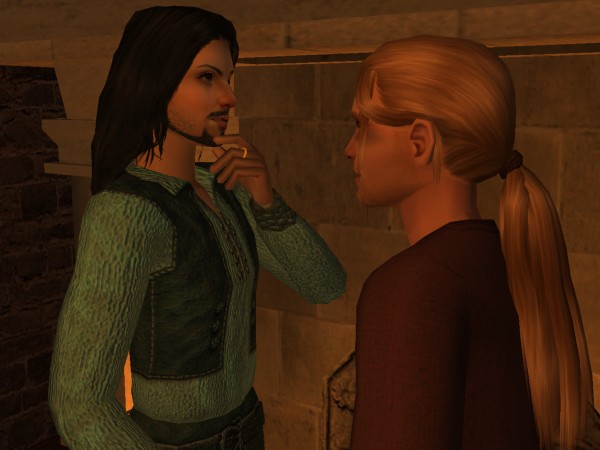
He paused and leaned lower, attempting to read Baldwin’s reaction in his face. He must have been satisfied by what he saw, for he stood taller and chuckled more deeply than Baldwin would have expected of his slight frame.
“I told you how faster I rode,” he said, gingerly patting the back of his thigh.
Baldwin mustered up a laugh. “I concede that you are a better rider than I shall ever be a sailor.”
“So, here is how we did,” Njal continued briskly.
He lifted the flat of his palm to make a sea, and began to draw battle plans across it with a horn-nailed finger.

“Eirik and Diarmait mac Aeda his friend, they went to Lord Eochaid and said, let us come together with our ships. And so, we took the black sails of Colin’s ships and the red and blue and green sails of Eirik’s ships, and we put the sails on the other ships, so men will think the Gaels are Norsemen and the Norsemen are Gaels at sea. Ja?”
Baldwin nodded.
“So.”
Njal sailed his nail down the length of his index finger and veered out across his palm, following his life line until he turned sharply in to approach his thumb head-on.
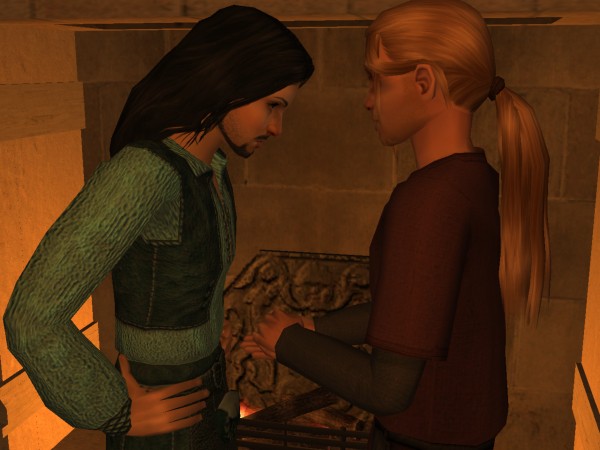
“We Norsemen with black sails, we sail straight before the harbor when the tide is low. But in Ramsaa they say, seeing our black sails they say: These ships of Colin, they sit too low, they cannot come into the harbor at low tide. They do not come before tomorrow. And, same time, the Gaels with colorful sails, they sail down along the coast like if they are so, so fragile ships, ja?”
Viking to the bone, he paused to laugh at the supposed fragility of Eirik’s fleet, and he lifted his tracing hand to give Baldwin a companionable tap on the breastbone, soldier to soldier.
Baldwin obliged him with a laugh, though privately he thought it just within the range of plausibility that Eirik’s collection of shallow-bellied antiquities could ever even sail upon the open sea.
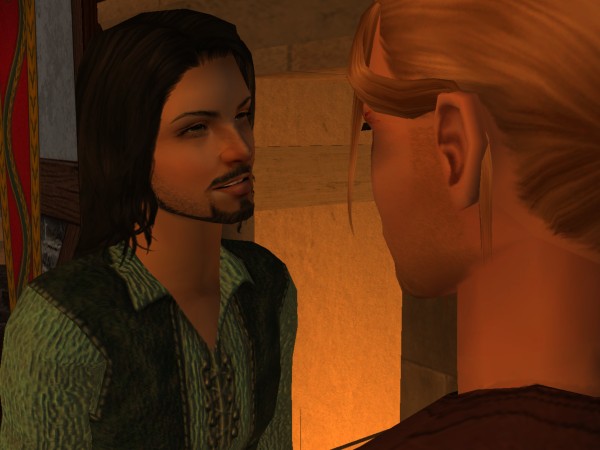
“And the Ramsaa men, they take their ships, and they say how they can chase these ships of Eirik out too far and they break in the storm. Crazy, ja? But three hundred marks they get, if Eirik is dead. So! They make a try. But they get a bad surprise when they find these Gaels in their big ships with our sails, and their axes and arrows. And in Ramsaa the people have another surprise, black-sailed ships sailing over the shoals like there is no shoals there.”
He stopped and chuckled smartly, pink-cheeked and apparently quite pleased with himself.
Baldwin ventured a smile. “Ingenious.”
Njal’s bulging brow attempted a scowl, as though he did not understand the word and mistrusted the meaning.
“Very clever tactic,” Baldwin added, and Njal’s forehead relaxed.
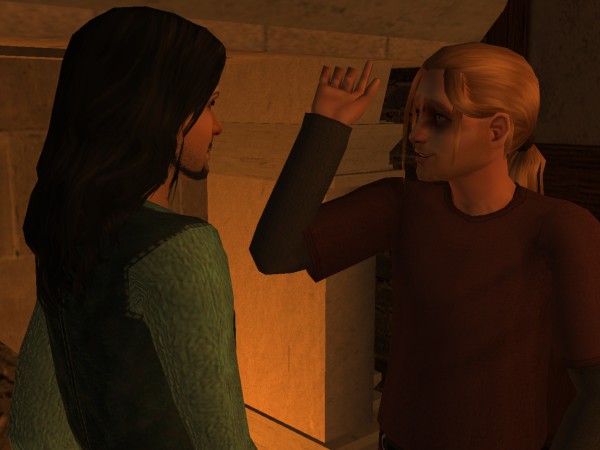
“Ja?” he smiled. “But so.” At once his expression darkened into a definite scowl. “All this is in the letter. Now I tell you the other half of this story. How Eirik he told Diarmait and Eochaid and these men: do not kill these enemies, we take prisoners and ask ransom, ja? Some of these men, they are our old friends, like how Whitehand and Eirik they were friends in past times.”
Baldwin nodded. As a knight formerly in the employ of Normans, this was an uncomfortable state of affairs he understood perfectly well.
So encouraged, Njal leaned closer and confided in a whisper, “But these men, these are Gaels. Savages. Once they start to fight, they do not stop until everywhere is blood. They catch the blood of their enemies in cups and drink, and it makes them drunk.”
Baldwin leaned away and exhaled deeply, trying to clear his lungs of the saline reek of the man, as if this would help him clear his mind of these vile accusations.
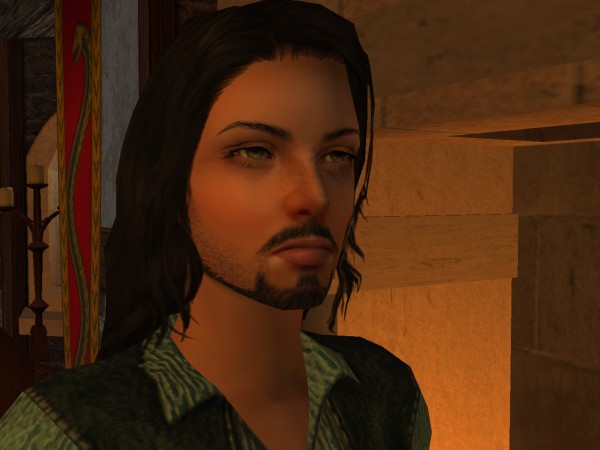
Violent as they might occasionally be, Baldwin did not believe the Gaels of modern times ever actually drank human blood. The idea of such a genteel man as Sir Malcolm ever doing so would have been laughably absurd, if it were not so revolting.
However, he was not entirely surprised to learn that an illiterate, superstitious young sailor believed it was true, and he knew better than to try to convince him otherwise.
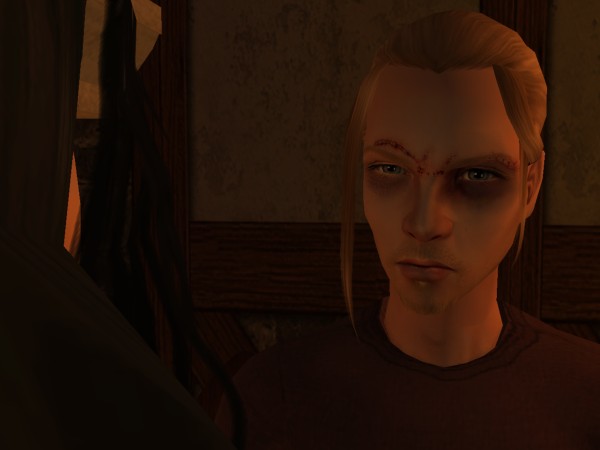
“They killed every Norseman they met in the ships,” Njal continued. “And let live only Gaels. And when they came to land in Ramsaa, the people saw how they were all red and drunk with blood, and they were afraid. But did Diarmait tell them to be calm and not afraid? He did not. He made a loud talk in the square, all in Gaelic, and made a fire in all the people, like they were thirsty to drink blood also. And Diarmait and Eochaid they went inside, and Eirik, he was so angry like a god, and he went inside to tell them. And who was outside with the people?” he asked grimly. “No one was outside.”
Baldwin stepped back and swallowed. He knew what was coming next, though young Diarmait and Eochaid and Eirik seemed not to have known.

Twice in his life he had witnessed the horrors wrought by a seething mob. No battle had ever been so savage. No execution had ever been so cruel. It was unlike any human enterprise: it was a force of nature, like a wildfire, like a whirlwind.
“First it is just a fire here, a fire there, in the houses of the Norsemen. Ja? Then all the wives of Norsemen,” Njal murmured, shuffling ever closer to Baldwin, and forcing him with his slight body to step away.
“All the children of Norsemen,” he breathed. “All the boys, the girls, the babies who are not Gaels son of Gaels son of Gaels. First they chase them to the harbor, where we are standing in our ships. Then that is not enough, to shout and scare and chase. Then they take torches and knives to make them go in the ships. And then not the ships, the river. And if they do not jump, they throw.”

His wind-roughened hand shot out and grabbed a velvety flap of Baldwin’s vest. “Babies!” he hissed. Baldwin knocked him away with the back of his arm.
Just then the door opened, and Affrais came clattering in, carefully balancing the heavy tray with its glossy mugs and pitcher of hot spiced wine. Baldwin dared not look at her: his gentle, pretty, innocent little wife was now as out-of-place in this room as Njal had been when Baldwin had arrived.

“Pardon me, gentlemen,” she called. “Your wine is ready, when you are.” Just before the silence grew awkward, she added, “Is there anything else I can get for you?”
Baldwin was about to thank her and dismiss her when Njal whispered, “A horse?”
Baldwin hooked his thumb into his belt and called back to her, “Have Njal’s saddle put on a fresh horse. And have mine saddled as well, chérie. I must ride to the King at once.”
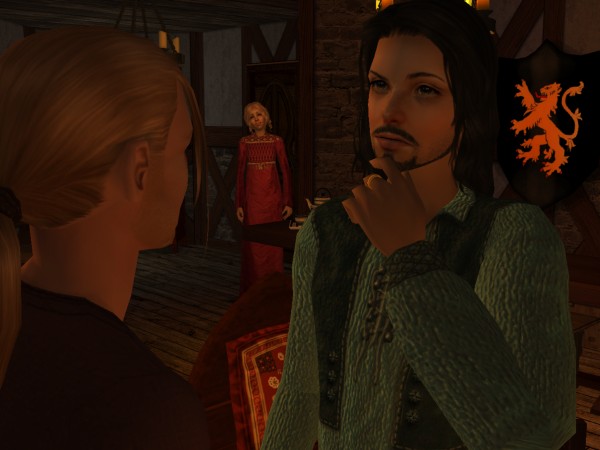
“At once,” she echoed. She tittered weakly and went out before Baldwin had the presence of mind to thank her. He was most thankful she had not heard Njal’s last words.
Njal nervously rubbed his hands together until the door had closed. Then he hissed, “Ever see babies in the water? They can swim a little, like so!” He paddled at the air with his dirty hands and chuckled darkly. “Not long! Ice water! At night! Tcha!”
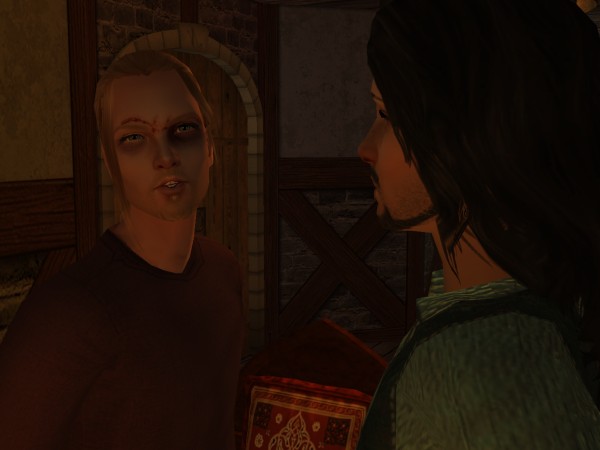
He cracked his hands together and tossed back his head in disgust. Baldwin was beyond being startled.
Njal pointed at his brow. “So! How this happened? Eirik—I never saw when he came outside and came in the water—we were half on the ships and half in the water to save the women and babies—and when this happen—”
He choked and clapped his hand over his mouth for an instant, before wrapping his arms tightly around his chest and continuing in a taut, half-restrained shriek, “I go straight down in the dark water, holding a baby like so! And Eirik he pulled me out! But baby is gone! So!” he sobbed.
He threw open his arms again and looked as if he were about to fall. Baldwin caught his sleeves, patted his arms down, and clasped his shoulders to hold him safely still.
“Njal, Njal, my friend,” he soothed. “It’s over now, it’s over…”
“Ja, so!” Njal agreed. He giggled weirdly and shivered before the fire, but such an out-of-place reaction was nothing battle-hardened Baldwin had not seen before.
“First time I ever tell this story,” he admitted shakily.
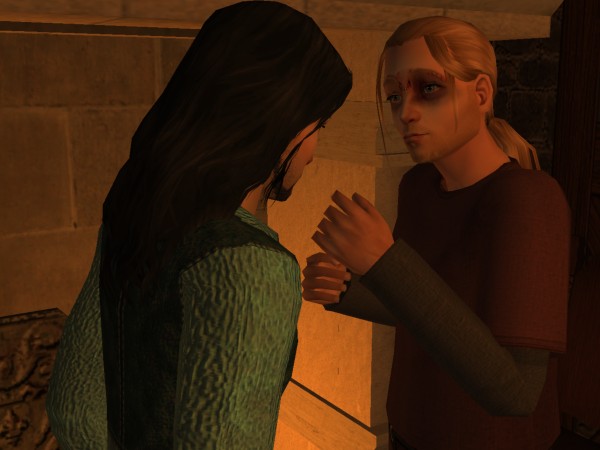
“Give yourself some time,” Baldwin advised.
“Eirik says, don’t tell this story right now. Only one time, to you. And so, you tell your King. And so—I don’t know…” he mumbled.
He lifted his hand as if in a habit of pinching the bridge of his nose or rubbing his brow, but when his fingers brushed his wound he simply let it fall. He looked as stunned as a man who has just been struck squarely across the forehead with the blade of an oar. He looked small and young and forlorn: an illiterate, superstitious, tempest-tossed boy-captain, faithfully executing the unfathomable orders of an unfathomable man.
“I shall tell him all,” Baldwin swore.
Roused from his dark reverie, Njal glanced up, squinting and blinking as if Baldwin’s very face were a source of light.
“So, you tell your King,” he said stubbornly, “and no other one. And mostly not to tell Young Aed. He is here, ja?”
Baldwin nodded. He had not yet been to see the interesting young man himself, but so he had heard.
“Tsch! Eirik! How he knows that?” Njal smiled sightly and shook his head in mingled amazement and admiration.
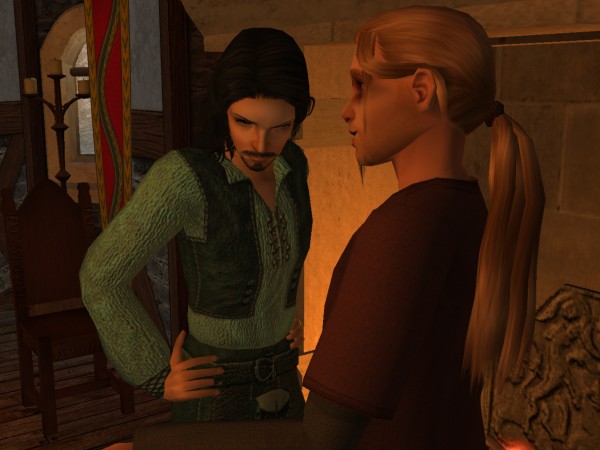
“I shall personally deliver this message to the King and no other,” Baldwin promised. He opened his purse to pull out the corner of the letter in a sign of good faith, but Njal grabbed his wrist to stop him.
“Young Aed he does not see this letter,” he warned. “Young Aed he does not hear this news.”
“I shall tell Sigefrith,” Baldwin assured him, and then he hesitated, wondering how much he could swear.

“I shall tell him everything you said. But I cannot speak for my King.”
Njal nodded as though satisfied. “So, Sigefrith he knows who is his friends.”
He released Baldwin’s wrist to clap him on the shoulder, man to man, and mustered up another wry and raffish smile.
“N’est-ce pas, mon ami?” he chuckled, startling Baldwin with more words of French than he would have thought the illiterate young Norseman could possibly know.
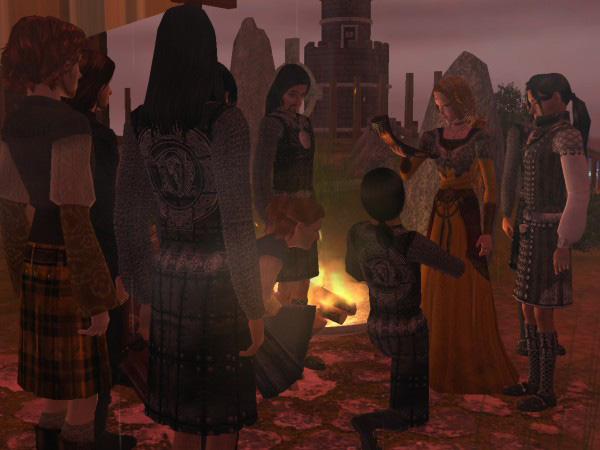


 He certainly told a different story than the one Eochaid told Old Aed, didn't he? He made no effort to sugar-coat it, and didn't throw in any illusions of grandeur or anything. He's a good guy.

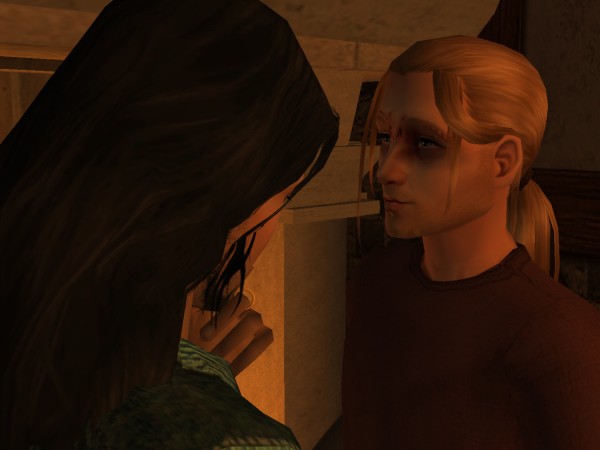
 And is Njal's tale at all historically accurate? Apologies if you already answered that in an earlier chapter. Oh, and as a side note, up until about the third picture I kept wondering when Estrid was going to be described...and then I realized it was Ana. Uncanny semblance with the hair and features.


 Chapters
I know it's a bit immature, but I am deeply amused by all the "flirting" animations between these two.
I also love seeing pregnant Ana and Freya.
Ach, Njal! I wanted to give him a hug by the end of this...